
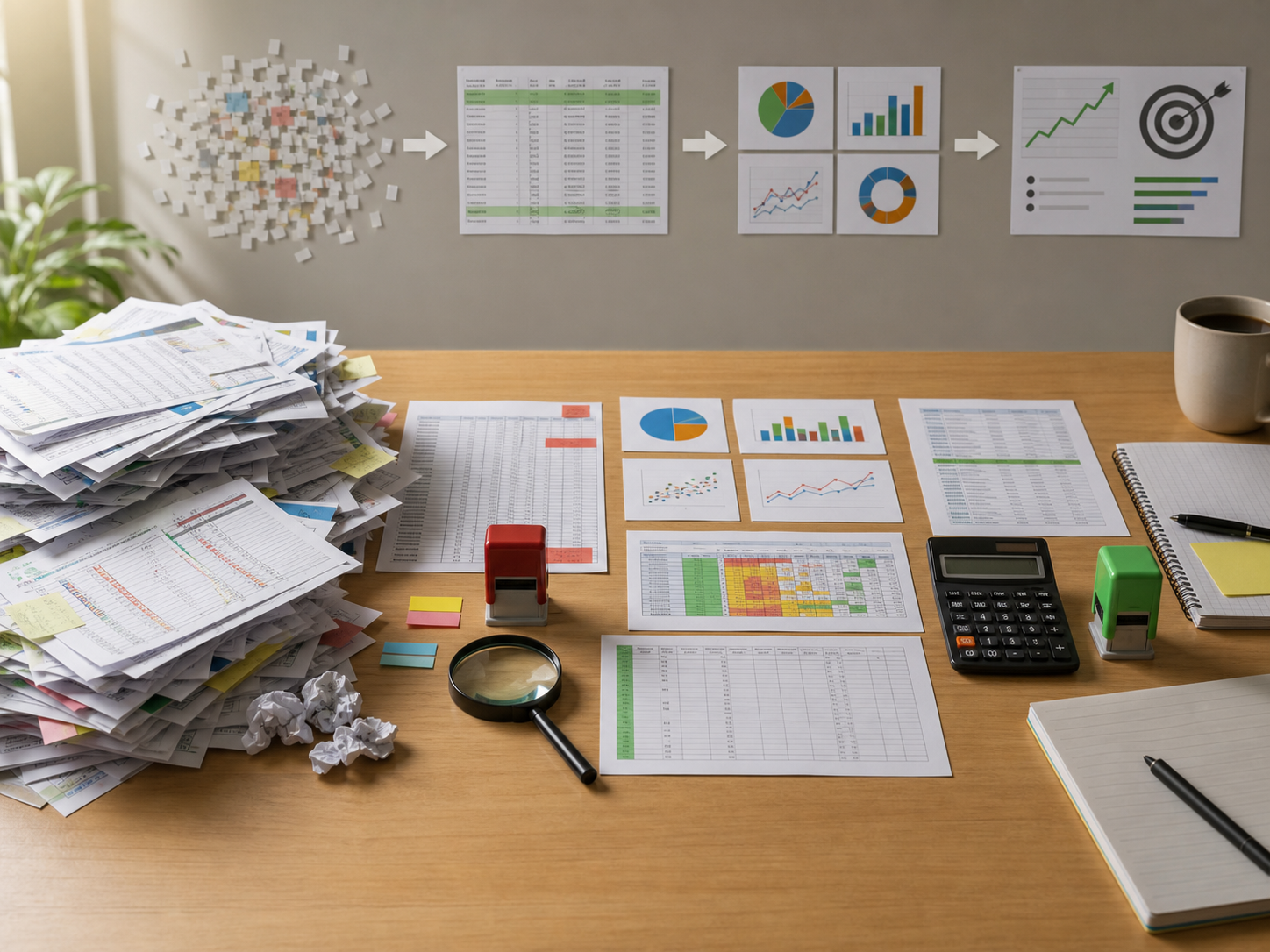
The promise of AI at work is not that every professional suddenly becomes faster at everything. The useful promise is narrower and more believable: fewer stalled handoffs, cleaner drafts, better preparation, and less time spent hunting for context.
This matters because a research workflow built around confidence rather than speed alone is not built in one dramatic setup session. It grows through small, repeatable improvements: a better prompt for rough notes, a cleaner way to turn updates into tasks, a habit of checking assumptions, and a place to store decisions so people can find them later.
The Workflow That Usually Works
Think in four passes: collect, clarify, draft, and decide. Collect the raw material before asking for output. Clarify missing details by having AI list assumptions and open questions. Draft two or three workable versions. Then make the decision yourself, using the AI result as a structured starting point rather than an authority.
This flow is slower than a one-line prompt, but it is faster than cleaning up confident nonsense later. It is especially helpful when the work affects customers, teammates, budgets, or deadlines. AI should compress the messy middle of work, not erase the review step that keeps the work trustworthy.
Signals It Is Paying Off
You know the workflow is working when it saves attention, not just keystrokes. Meetings produce clearer next steps. Reports require less cleanup. Emails leave the outbox faster without sounding careless. Team members ask fewer repeated questions because the answer is easier to find.
Track one or two simple measures for a month. How many minutes did the workflow save? How often did the output need heavy rewriting? Did it reduce missed follow-ups? Did people actually use the result? Productivity gains that cannot survive these questions are usually more theater than system.
A Realistic Example
Imagine a typical week where preparing a market brief before a strategy meeting. Without AI, the work may involve rereading messages, rebuilding context, drafting an update, checking dates, and deciding what deserves attention. With a focused AI workflow, the first draft of that structure appears in minutes. You still edit, but you begin from organized material instead of a blank page.
The result should not be treated as final just because it is tidy. Read it like a capable assistant prepared it: useful, fast, and occasionally missing the nuance. Add the context only you know. Remove anything that sounds generic. Confirm the details that carry risk. This is where the human advantage stays visible.
Common Mistakes
The biggest trap is mixing unverified AI claims with facts from primary sources. Another is adding AI to a process nobody has defined. If ownership is unclear, data is messy, or “done” means something different to everyone involved, AI will mostly accelerate confusion. Clean up the workflow before automating it.
Keep It Lightweight
Review the workflow once a week. Keep prompts that repeatedly save time. Delete prompts that create long, impressive answers nobody uses. Notice which outputs move work forward and which outputs simply produce more text. The best systems get quieter with use because they remove steps instead of adding rituals.
If you are introducing the workflow to a team, start with one shared habit. For example, every AI-generated summary must include decisions, owners, deadlines, risks, and open questions. A shared standard is more valuable than everyone experimenting in isolation, especially when several people depend on the output.
A Simple 7-Day Test
Run the workflow for one week before judging it. On day one, choose the repeated task and write the exact output you want. On day two, collect three real examples from your normal work. On day three, create a reusable prompt that includes audience, context, constraints, and format. On day four, test the prompt against messy material, not a perfect sample. On day five, revise the prompt based on what it missed. On day six, connect the result to the tool where the work continues. On day seven, decide whether it saved enough attention to keep.
This small test prevents overbuilding. It also gives you evidence. If the workflow only saves five minutes but improves quality on a high-value task, it may still be worth keeping. If it saves thirty minutes but creates errors that require review from three people, it is not really productivity. The goal is useful leverage, not just faster output.
How to Measure the Improvement
Look for practical signals: fewer missed follow-ups, shorter preparation time, clearer handoffs, faster first drafts, better documented decisions, and fewer repeated questions. You can also ask the people around the workflow whether the output is easier to use. That feedback matters because workplace productivity is rarely private. One person’s shortcut can become another person’s confusion if the result is unclear.
After two or three weeks, create a short playbook. Include the trigger, the input needed, the prompt, the review checklist, and the destination for the final output. This turns an individual trick into a dependable routine. It also helps new teammates understand how AI is being used, which reduces suspicion and makes the workflow easier to improve over time.
The Practical Takeaway
Do not build an AI setup around novelty. Build it around one repeated work problem, one clear output, one review habit, and one destination. That modest structure is what turns AI from a clever app into daily leverage.